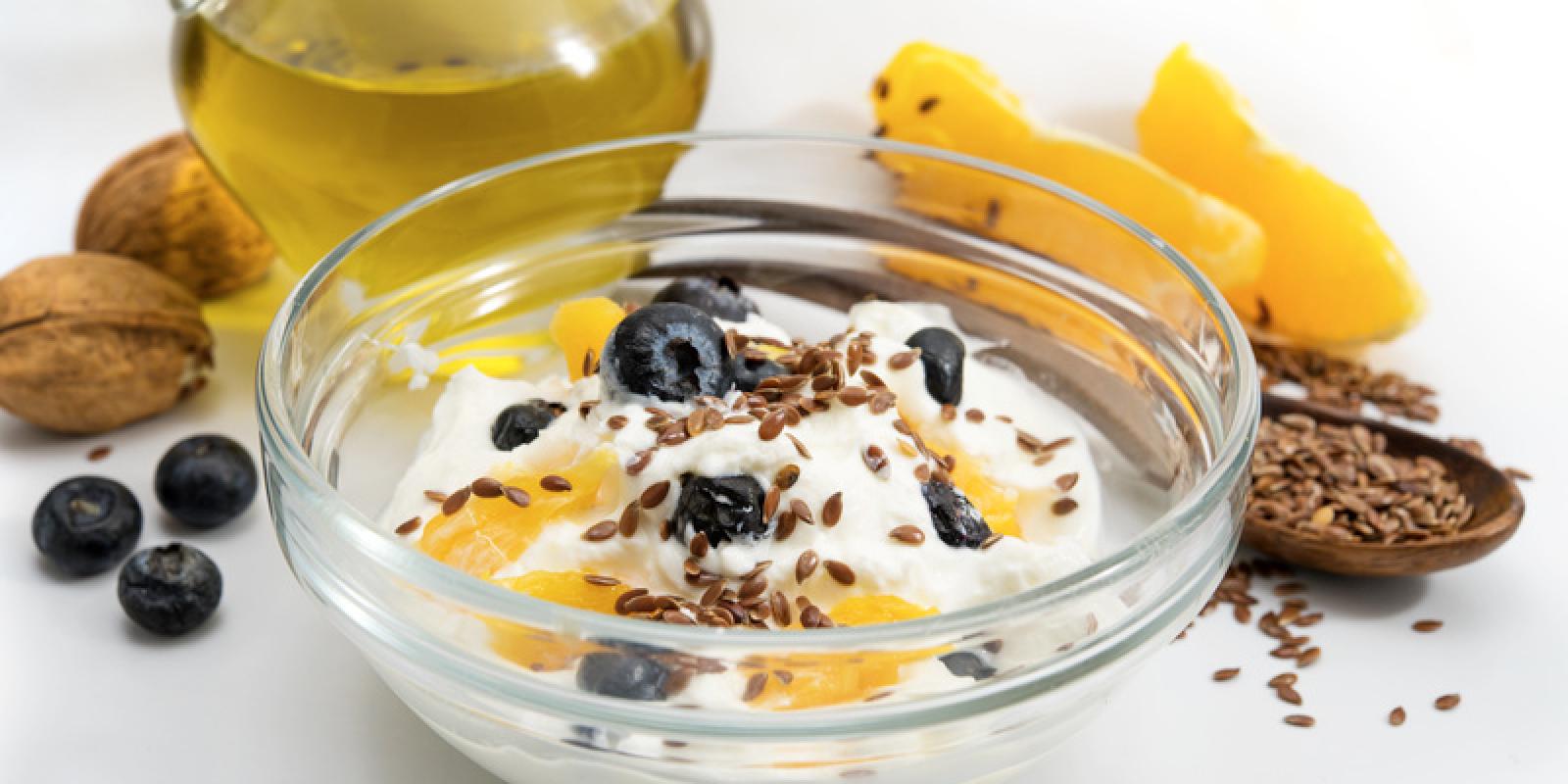
The Budwig diet was developed by the German chemist Johanna Budwig (1908-2003). Its central component is a mixture of flaxseed oil and cottage cheese or quark. The diet also emphasizes fresh fruits and vegetables, juices, whole grains, and nuts.
Budwig advocated the consumption of natural, minimally processed foods to provide essential nutrients and to avoid substances she believed could disrupt cellular metabolism, particularly cellular respiration. She proposed that combining the polyunsaturated fatty acids found in flaxseed oil with sulphur-containing proteins from cottage cheese or quark could influence the growth and progression of malignant tumours.
Efficacy
The proposed anticancer effects of the Budwig diet have not been confirmed in clinical research. No peer-reviewed clinical trials have evaluated the diet as a cancer treatment or for cancer prevention.
Safety
While several components of the diet align with general healthy eating recommendations, concerns have been raised about its relatively high fat and protein content, which may exceed recommended dietary levels. The restrictive nature of the diet may also increase the risk of nutritional imbalance.
Description
The Budwig diet was developed in the 1950s by German chemist Johanna Budwig (1908-2003). At the core of the diet is a mixture of freshly ground flaxseed and low‑fat cottage cheese or quark. (Budwig Stiftung 2026)
The diet is based on a theory developed by Budwig about fats, proteins, and cellular oxygenation described in several of her books (Budwig 1996, Budwig 2000, Budwig 2008, Budwig 1994, Budwig 1994) some translated into English (Budwig 2008, Budwig 1994, Budwig 1994). (Budwig Stiftung 2026)
Components
The Budwig diet is largely vegetarian, emphasizing fruits, vegetables, whole grains, and nuts. Foods should be fresh, preferably organic, and eaten raw or only lightly cooked.
The diet excludes refined sugars, meat, fish, hydrogenated and animal fats, alcohol, caffeine, refined grains, preservatives, processed foods, as well as smoking.
Alleged indications
According to Budwig’s theory, disease is linked to unhealthy fats, impaired cellular oxygenation, and nutritional imbalances; the combination of flaxseed oil and quark/cottage cheese is postulated to restore cellular health.
Budwig claimed that it therefore can help prevent, improve, or even treat various diseases, including cardiovascular disease, arthritis, diabetes, multiple sclerosis, as well as cancer. She reported a high rate of success in treating cancer with her method, but she did not present scientific evidence to support these assertions.
Mechanism of action
Budwig's theory postulates that cancers are caused, among others, by "inadequate cell maturation and incomplete cell growth" as well as "impaired cellular respiration." According to her hypothesis the enhancement of cellular oxygenation is the most important mechanism. Budwig was influenced by Warburg’s hypothesis that cancer cells rely on low-oxygen (anaerobic) metabolism. She proposed that a lack of proper fatty acids impaired cellular respiration and that the blend of polyunsaturated fatty acids found in flaxseed with sulfhydryl-containing proteins found in cottage cheese or quark restored oxygen uptake. (Budwig 2008, Budwig 1956) There is no recognized scientific basis for these claims.
Application and providers
The Johanna Budwig Foundation trains naturopaths (“Heilpraktiker”, nutritionists, and physicians through webinars and seminars to become certified “Budwig advisors.” (Budwig Stiftung 2026)
The proposed anticancer effects of the Budwig diet have not been confirmed in clinical research. No clinical trials of the Budwig diet are available in the peer-reviewed scientific literature to support claims that it can prevent, slow, or treat cancer.
The proposed anticancer effects of the Budwig diet have not been confirmed in clinical research. No clinical trials of the Budwig diet are available in the peer-reviewed scientific literature to support claims that it can prevent, slow, or treat cancer.
The safety of the Budwig diet has not been systematically assessed. Some principles of the diet align with general healthy eating recommendations; e.g. emphasizing fruit and vegetables, whole grains and dietary fibre, unsaturated fats and avoiding processed foods and meats, limiting added sugars. (ACS 2026)
The consumption of large amounts of flaxseed oil may result in a fat intake that is higher than standard dietary recommendations. (Muscaritoli 2021; S3-Leitlinie 2026)
Generally, concerns have been raised about the restrictive nature of the diet if followed rigidly, which may increase the risk of nutritional imbalance, particularly in individuals with cancer who have elevated nutritional needs. (Muscaritoli 2021; S3-Leitlinie 2026)
Adverse events
Large amounts of flaxseed oil can cause loose stools and diarrhoea. (NatMedPro 2026).
Allergies to components found in flaxseed have been reported but seem to be very rare (Fremont 2010).
Contraindications
Not known.
Interactions
Theoretically based on pharmacology: Flaxseed oil used in combination with anticoagulant or antiplatelet drugs might have additive effects and increase the risk of bleeding. (NatMed Pro 2026)
ACS, American Cancer Society. American Cancer Society Guideline for Diet and Physical Activity for Cancer Prevention | American Cancer Society [website]. 2026; accessed August 19, 2026.
Budwig J. Cancer: The Problem and the Solution. Nexus GmbH; 2008.
Budwig J. Cytostatic or cytodynamic treatment of cancer. Hippokrates. 1956;19:605-12.
Budwig J. Das Fettsyndrom. Auflage 4A. Freiburg i. B.: Hyperion Verlag; 1996.
Budwig J. Flax oil as a true aid against arthritis, heart, infarction, cancer and other diseases. 3rd Edition. Vancouver: Apple Publishing; 1994.
Budwig J. Krebs, ein Fettproblem. Richtige Wahl und Verwendung der Fette. Freiburg i. B.: Hyperion Verlag; 2000.
Budwig J. The oil protein diet cookbook. Vancouver: Apple Publishing; 1994.
Fremont S, Moneret-Vautrin DA, Franck P, Morisset M, Croizier A, Codreanu F, Kanny G. Prospective study of sensitization and food allergy to flaxseed in 1317 subjects. Eur Ann Allergy Clin Immunol. 2010;42(3):103-11.
Leitlinienprogramm Onkologie, S3-Leitlinie Klinische Ernährung in der Onkologie, Version 1.0, 2026
Muscaritoli M, Arends J, Bachmann P, Baracos V, Barthelemy N, Bertz H, et al. ESPEN practical guideline: Clinical Nutrition in cancer. Clinical Nutrition. 2021;40(5):2898-2913. doi:10.1016/j.clnu.2021.02.005
NatMed Pro 2026. Flaxseed oil. NaturalMedicine Databases, available online (requires subscription, accessed 29th September 2026.
Citation
CAM Cancer Collaboration. Budwig diet [online document], Sept 29, 2026
Document history
Assessed as up to date and revised in September 2026 and July 2023 by Barbara Wider and Dana Mora. Revised in May 2021, August 2020, January 2019 and February 2017 by Barbara Wider. Fully revised and updated in January 2016 by Markus Horneber. Assessed as up to date in January 2015 and August 2013 by Barbara Wider. Summary first published in May 2012 by Luc Geeraert.
Next update due: October 2029.
Photo: mp37860777 from Mostphotos.com, licence via UiT The Arctic University of Norway.